Enemy Contact Near FSB Fontaine
Summary
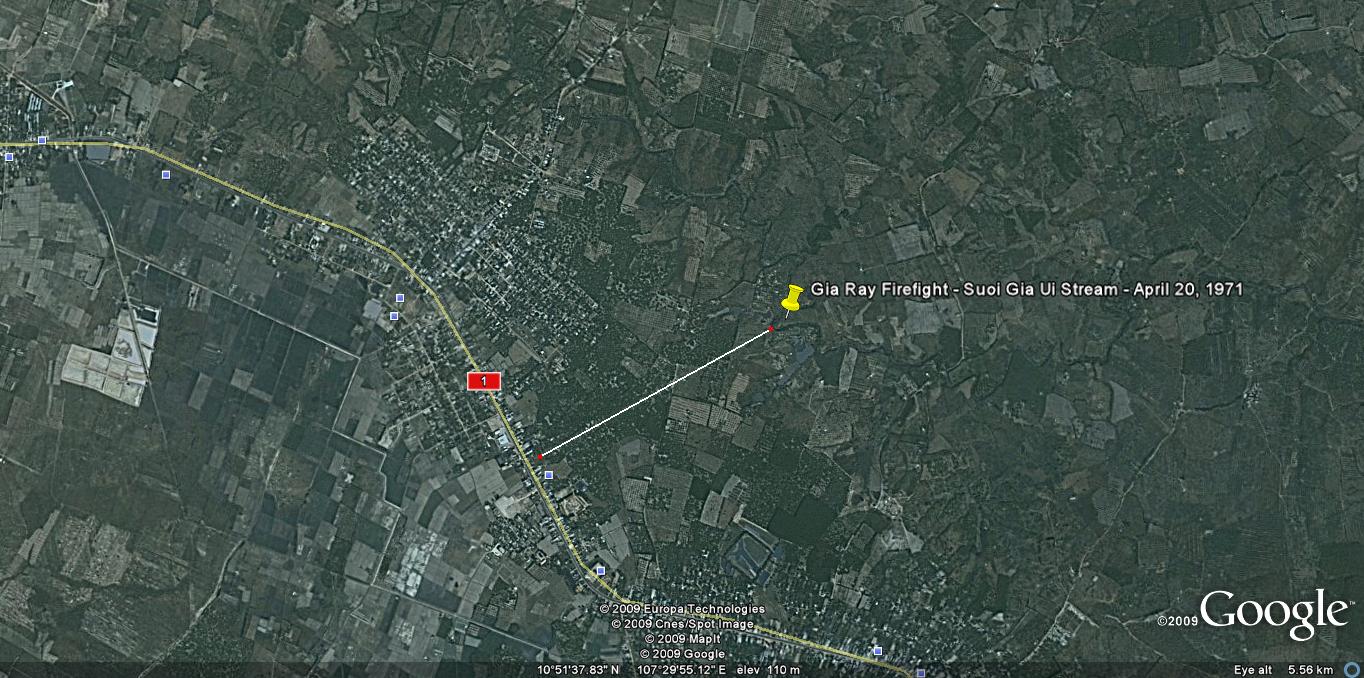
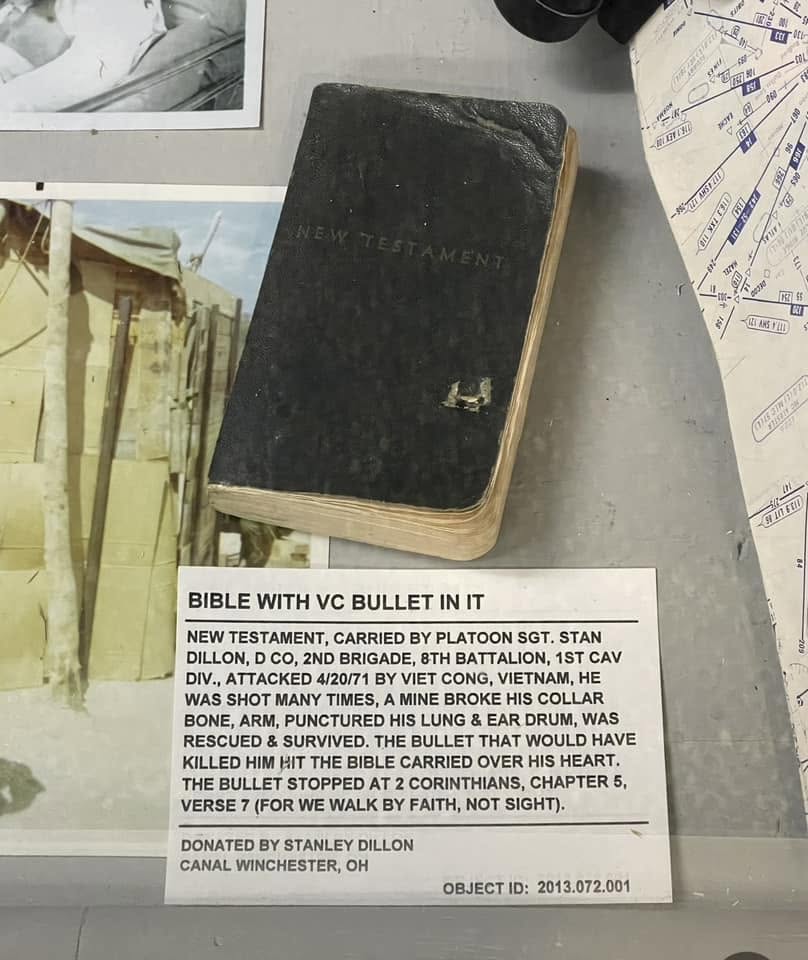
On April 20, 1971, D Company, 2/8 Cavalry air-assaulted into an area near Gia Ray, Long Khanh Province. Range Platoon, moving along the Suối Gia Ui stream approximately 12 kilometers southeast of Gia Ray and 2 kilometers north of Highway 1, walked into the fortified base camp of the 83rd NVA rear service unit and its security detachment. The lead elements — CPL James Cardwell and CPL Danny Drinkard walking point — were killed instantly by tree-mounted, command-detonated Chicom claymore mines. Heavy automatic weapons fire from bunkers with six feet of mud and log overhead cover pinned the platoon. Range suffered nearly 90% casualties: three killed, approximately eighteen wounded, with only three men uninjured.
CPL Joseph Hall moved forward to assist the wounded and was killed. With SSG Stan Dillon, the platoon sergeant, down with multiple wounds, CPL Stanton Sargent took over the M-60 machine gun1 and held the enemy at bay with sustained fire while wounded soldiers were evacuated across the stream. Company Commander CPT William Neal later recalled hearing the M-60 and thinking, "I hoped it was one of ours." Sargent was struck by shrapnel from a Chicom claymore and was medevacked unconscious. He died the following day. Four members of Range Platoon were awarded the Silver Star for their actions: Sargent, SSG Dillon, and the two men on the second M-60.
The surviving elements of Range Platoon withdrew across the stream under fire. The terrain compounded every difficulty: the north bank of Suối Gia Ui is significantly higher than the south, a product of centuries of drainage off Núi Chứa Chan cutting a recessed channel into the rising ground. The 83rd NVA had built their bunker complex into this elevated reverse slope, giving them direct downward fire onto the stream crossing and the south bank. Cat Platoon on the lower south bank was effectively firing straight up into a steep earthen wall; their rounds hit the bank face while the enemy fired down from prepared positions on the lip above. Cat Platoon maintained suppressing fire from the south bank, but the elevation differential meant the direct fire support Range most needed could not reach the bunkers. Supporting fires were brought to bear throughout the afternoon: direct and general support artillery (including 8-inch guns from Xuan Loc), aerial rocket artillery, Air Cav gunships, and six USAF F-100s dropping 500-lb bombs on the bunker complex. Three KIA could not be retrieved from the ambush site that day and were left under enemy guns with great reluctance. They were recovered in a combat assault on April 23.
The night of April 20–21 was spent in a defensive perimeter east of the bunker complex, with continuous artillery fire directed through the night by Capt. Neal and acting FO SGT Steve Kahnke. Skull Platoon was choppered in as a late-afternoon reinforcement to reconstitute D Company's strength. The event directly precipitated the helicopter crash four days later that killed pilot CW2 Martin Fanning, for whom the next FSB was named.
Context and Contested Details
FSB name: Col. Bacon's deposition refers to "FSB Fanning" when describing the morning of April 20 — including General Abrams's visit to the fire base before the contact. This is almost certainly a retrospective slip. The FSB was not renamed Fanning until after the 4/24 crash, four days after this event. All other sources and the slug for this record use Fontaine.
Platoon naming: Bacon refers to the ambushed unit as "2d platoon," its numerical designation. All soldier accounts use the call-sign Range. This record uses Range throughout.
Contested — Neal's position during the firefight: Davis states (in a section redacted from his published account) that Neal and Cat Platoon remained on the south bank throughout the firefight and provided no direct support to Range. Neal's own account describes actively managing the withdrawal, directing medevacs, and ordering Cat's trail squad across the stream to flank behind Range. These accounts are not fully reconciled. Davis's characterization is retained in the archive repository but is not part of his published account.
Sargent DOW date: Davis states Sargent "died the next day." The Linda Martin oral history (widow's testimony, Angelo State University, 2018) confirms April 21 as the date of death. The Honor Roll entry for Sargent should reflect April 21.
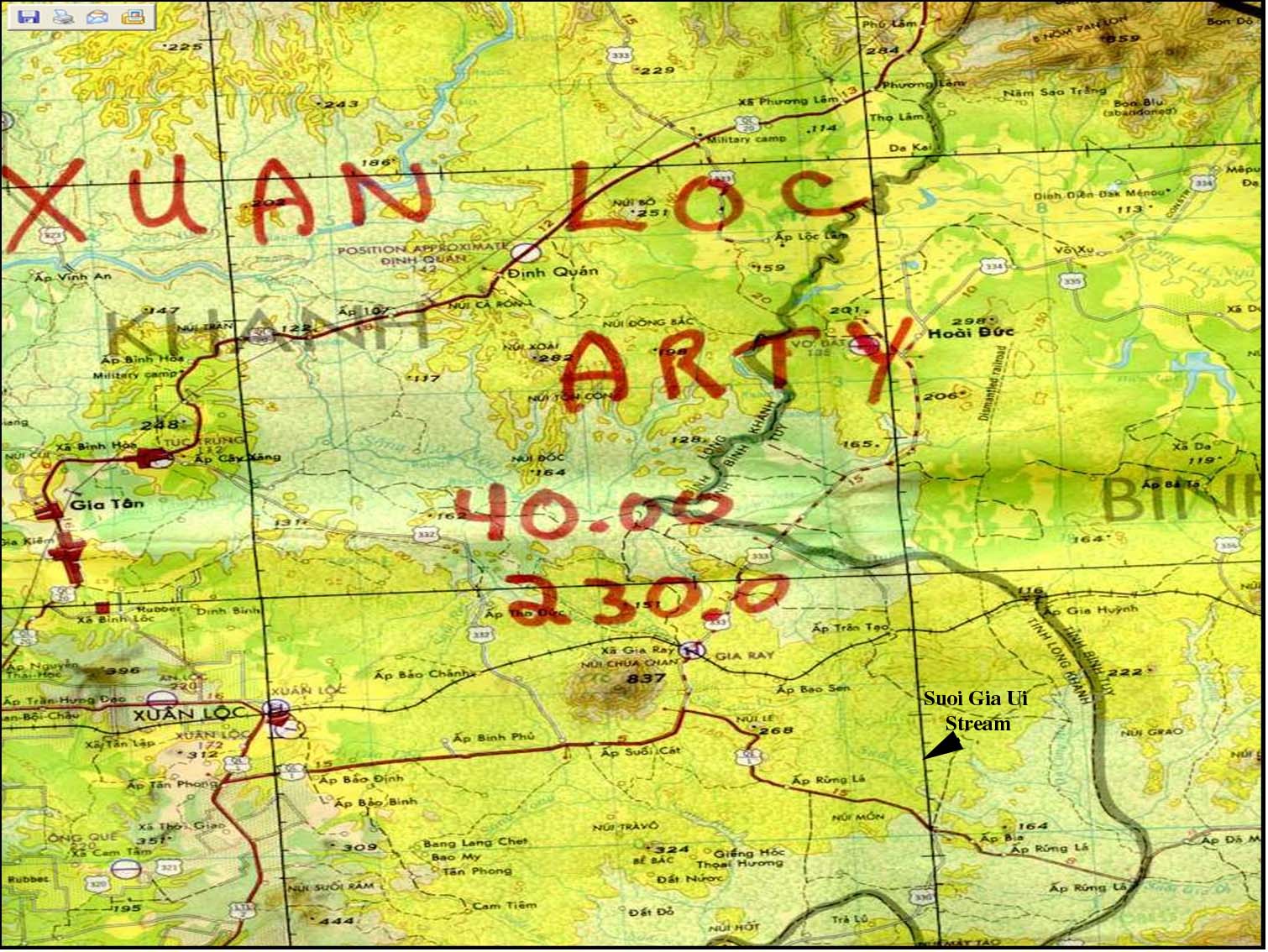
Stream name — resolved as Suối Gia Ui: The firefight took place on Suối Gia Ui, not Suối Tầm Bông. Geographic analysis (June 2026) confirms these are two distinct streams: Suối Gia Ui is the main stream flowing east out of Chứa Chan Mountain, running north of QL 1, at approximately 10°51'37.8"N, 107°29'55.1"E. Suối Tầm Bông is a smaller tributary that feeds into the Suoi Gia Ui basin from the northwest, located approximately 6km west at 10°51'54"N, 107°28'42"E. SSG Dillon's 2005 interview and the Maxey account both use Suoi Gia Ui, which aligns with Neal's directional descriptions. The record and all coordinates have been updated accordingly.
Terrain — north bank elevation: The north bank of Suối Gia Ui is significantly higher than the south bank at the firefight location. This asymmetry is the result of eastward stream flow combined with drainage off Núi Chứa Chan building upslope ground to the north. The 83rd NVA rear service unit exploited this by constructing their bunker complex into the elevated reverse slope of the north bank, with firing positions looking directly down onto the stream crossing and south bank. For Cat Platoon on the south bank, this meant firing upward into a steep earthen wall — rounds hit the bank face rather than the bunkers. This terrain feature is the primary reason Cat's direct fire could not suppress the NVA position from the south, and why the withdrawal required a lateral flanking movement to find a break in the high bank. This also directly supports the oq-08 working theory: the crossing action attributed to Skull in the Maxey account (moving west along the stream to find a crossing point) is precisely the kind of maneuver Cat's trailing squad would have had to execute to get across that high-banked stream.
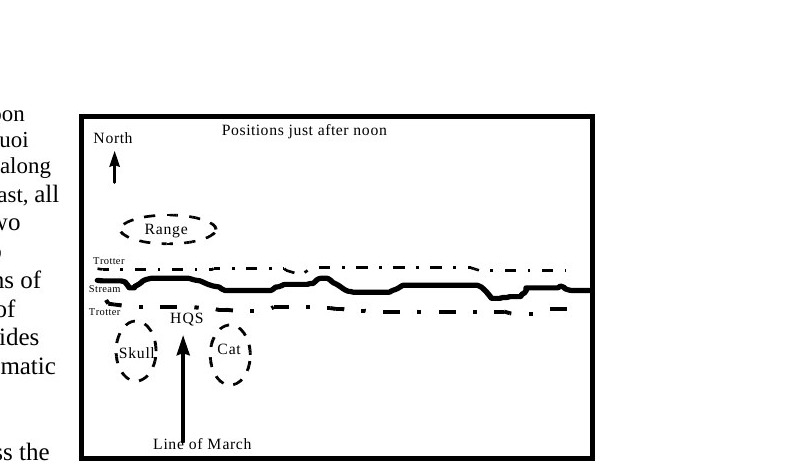
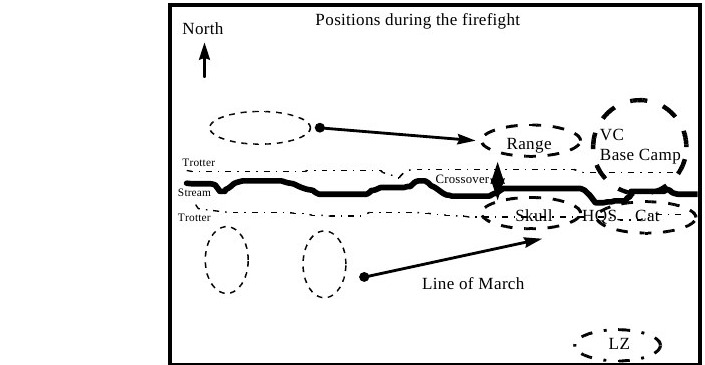
Skull Platoon's role — Maxey account vs. other sources: The Maxey document attributes a crossing action to Skull Platoon during the firefight, with diagrams showing Skull on the south bank at the crossover. This conflicts with all other accounts, which place Skull as a late-afternoon reinforcement choppered in after the engagement. Working theory: Maxey (or his source) misidentified Cat's trail squad as Skull. The crossing action described in the Maxey text — moving west along the stream and coming in behind Range — is consistent with Neal's account of Cat's trail squad. The Maxey diagrams are included in the event photo archive with this caveat noted in the captions. See oq-08.
Aftermath — the brigade's bunker-attack training
The kind of fight Range Platoon walked into on April 20 — a fortified, well-camouflaged NVA bunker complex in dense jungle — was becoming a recurring and costly problem for the 1st Cavalry Division's units that spring. In his 1971 senior officer debriefing report, the commander of the 3rd Brigade (Separate), BG Jonathan R. Burton, recorded the brigade's institutional response:
"Since May 1971, combat units of the 1st Cavalry Division have sustained increased casualties when encountering the enemy in his bunker complexes. To remedy this situation, a bunker training course was established at [the Combat Training Center]. This training included a live fire exercise on how to attack a bunker complex utilizing the organic fire support of the Brigade. The training was conducted as a platoon problem since that was the size unit most frequently used in actual contact ... thick vegetation prohibiting movement and difficulty in sighting the enemy."
The report dates the casualty surge to "since May 1971" — a few weeks after this engagement — so April 20 is not cited as its cause. But the action is an exact, and unusually severe, example of the very problem the training was built to address: a platoon-sized element in heavy jungle, unable to see or suppress an enemy fighting from prepared, overhead-covered bunkers. The brigade framed the course as a "platoon problem ... the size unit most frequently used in actual contact," and named the same difficulties Range faced here — thick vegetation and the near-impossibility of sighting the enemy. Source: 3rd Brigade (Separate) Senior Officer Debriefing Report (DTIC AD0520447); see /events/3rd-brigade-separate-garryowen-1971/.
- Sargent named as the soldier who took over the M-60 after Hall was killed: SSG Dillon, telephone interview with Michael Maxey, October 2005, via maxey.info/stan-sargent-story.html. Neal's written account confirms an M-60 remained active on the north bank but does not name the operator. ↩
The three KIA — Cardwell, Drinkard, and Hall — could not be recovered from the ambush site on April 20. McGrew's calendar places a CA to Fontaine on April 23, corroborating recovery, but no source explicitly documents that mission. If you were there or know what happened, we want to hear from you.
Share what you know →Hall, Collins, and Schneck all performed actions that multiple accounts describe in terms consistent with valor citations. We have found no award documentation for any of them. If you have copies of citations or know what awards were issued for April 20, 1971, please contact us.
Share what you know →
 HM
HM