3rd Brigade (Separate), 1st Cavalry Division — 'Garryowen Task Force' (1971)
3rd Brigade (Separate) — "Garryowen Task Force," 1971
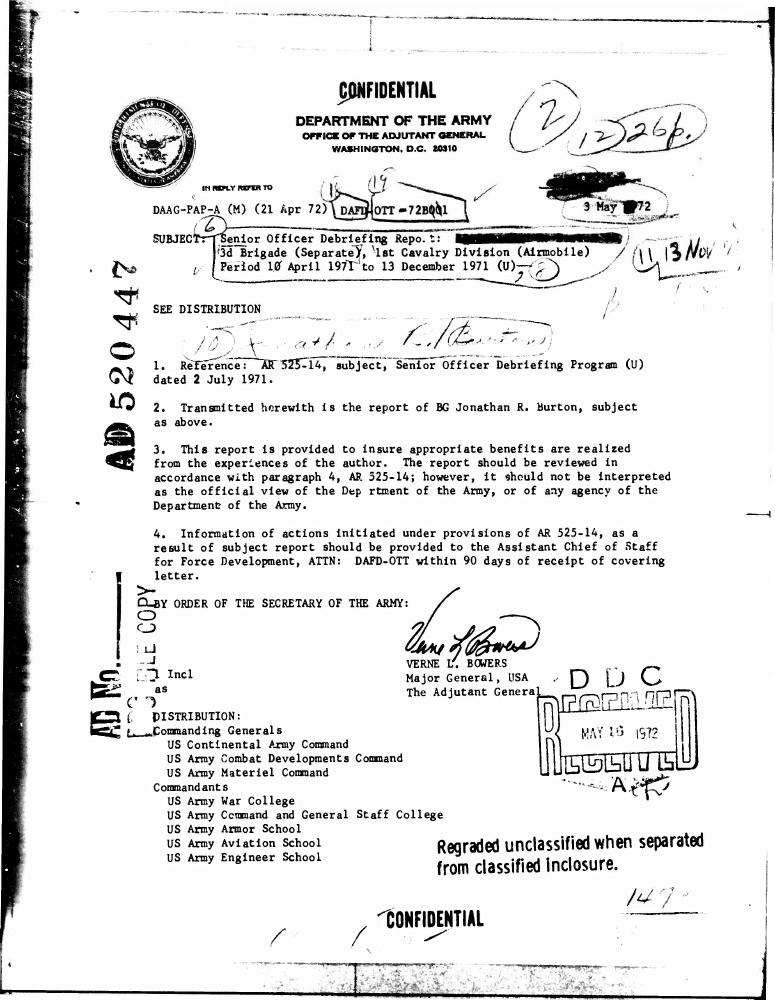
Context page — brigade level. Drawn from the Senior Officer Debriefing Report of BG Jonathan R. Burton, commanding general of the 3rd Brigade (Separate), 1st Cavalry Division, period 10 April – 13 December 1971 (DTIC AD0520447). It frames how the brigade operated; the full report is linked below to read in full. Treat the connection to specific D Company actions as highly likely context, not established fact.
The division standdown — 26 March 1971
The 1st Cavalry Division formally stood down in Vietnam on 26 March 1971, in a brief ceremony at the division's rear headquarters area at Bien Hoa (moved from the long-planned Phuoc Vinh site only that morning). Present were Gen. Creighton Abrams (commander of U.S. forces in Vietnam), Lt. Gen. Michael Davison (II Field Force), Lt. Gen. Nguyen Van Minh (III Military Region), and division commander MG George W. Putnam Jr. The posting of the division colors closed the ceremony; those colors were shipped to Fort Hood, Texas, to be reflagged for the 1st Cavalry Division (TRICAP), which assumed the assets of the 1st Armored Division. The division had arrived in Vietnam in September 1965. With the division gone, its 3rd Brigade remained behind as the separate "Garryowen Task Force" described below.
Source: "Standdown ceremony typifies First Team," CAVALAIR, 14 April 1971 — the 1st Air Cav Division weekly's standdown special edition (attached to this event under Documents).
The brigade. When the 1st Cavalry Division stood down and redeployed in the spring of 1971, its 3rd Brigade remained in Vietnam as a separate brigade — the "Garryowen Task Force," headquartered at Bien Hoa — to continue the division's mission. 2/8 Cav (D Company's parent battalion) was one of its four maneuver battalions (with the 2/5, 1/7, and 1/12 Cav, plus F Troop, 9th Cav and D Company, 229th Assault Helicopter Battalion). BG Jonathan R. Burton assumed command on 13 April 1971.
Mission. To conduct operations against enemy main and local force elements, their lines of communication, and base areas within the AO; to support the combined campaign and the Community Defense and Local Development plans in Long Khanh and Binh Tuy provinces; and to be prepared to execute contingency plans.
Area of operations. About 3,500 square miles — all of Binh Tuy, most of Long Khanh, and parts of Bien Hoa and Lam Dong — roughly two-thirds of the old division's AO held with one-third of its assets. Terrain ranged from coastal plain and single-canopy jungle south of QL-1 to the double- and triple-canopy War Zone D of Long Khanh north and west of QL-20. Key enemy: the MR-7 Rear Service Group (operating from Nui Be), Base Areas 305 and 306, and the 33rd NVA Regiment, on which brigade operations were oriented. Each of the four battalions was assigned a slice of the AO, its boundaries shifted "as intelligence and operations indicated" the enemy had moved.
How the brigade fought — and why it matters to the April 1971 D Company events. Burton describes a force in active contact less than fifteen percent of the time, oriented heavily on reconnaissance to "find and fix" an enemy who avoided contact, then reacting explosively. The signature method: a Ranger team or Air Cav element locates an enemy position or bunker complex; a "Pink Team" (an armed light observation helicopter and a Cobra) develops the target; an aero-rifle "Blue Team" goes in; and a one-company Quick Reaction Force, held on 30-minute notice, combat-assaults into the target area. Burton specifically describes "Mini-Cav operations — short-duration, platoon-sized, airmobile operations executed on the basis of reliable but highly perishable intelligence." That is, in the brigade commander's own words, the kind of operation that produced the April 20, 1971 contact near FSB Fontaine, when Range Platoon air-assaulted into the Gia Ray area and struck a fortified enemy rear-service bunker complex.
Caveats — highly likely context, not proof. This is a senior officer's retrospective debriefing, not a day-by-day record; it frames the brigade's doctrine and AO but does not narrate D Company's specific actions. The report's general AO enemy (the MR-7 Rear Service Group / 33rd NVA Regiment) and the "83rd NVA rear service unit" named in the April 20 event are the same type of formation but different designations — to be reconciled against the 2/8 Cav daily staff journal (NARA RG 472).
Brigade life — the rotation, Vung Tau R&R, and morale programs
Burton's report also documents the rhythm of a Skytrooper's life in 1971 — the kind of detail veterans often remember long after the operations blur together.
The rotation (Personnel Management, para. 1). Because of the vastness of the AO, rifle companies operated largely independently, each within the artillery fan of a firebase. The pattern: about fifteen days in the "bush," resupplied by helicopter every three or four days with ammunition, rations, and water — and, when a set-down LZ allowed, a hot meal and ice cream, a change of clothes, mail, newspapers, and other comfort items. Then five days on a firebase providing security, refitting, and undergoing bunker and marksmanship training. And every 45 days, each rifle company and recon platoon rotated to the First Team R&R Center for a three-day standdown — the in-country center that opened at Vung Tau in March 1971. Burton calls "Vung Tau R&R" a privilege "much sought after by all Skytroopers" and a major morale factor: knowing you would be back at the firebase every fifteen days and get in-country R&R every forty-five "provided a great lift for the individual rifleman."
Morale programs (para. 2). Two stand out: the "Flying PX" — PX services flown (and trucked, as a "rolling PX") out to the firebases, with contact teams to help with financial, personnel, and legal problems in the field — and "King for a Day," in which each week one company, battery, or aviation-platoon commander was brought to brigade headquarters for recognition: VIP treatment, the General's briefings, a tour of the area of operations with the Commanding General, and a 1st Cavalry Division memento.
Source: 3rd Brigade (Separate) Senior Officer Debriefing Report (AD0520447), Personnel Management.
Read the source
The full report is hosted here for download: AD0520447 — 3rd Brigade (Separate) Senior Officer Debriefing Report (PDF, ~2.4 MB) (also available from the Defense Technical Information Center at apps.dtic.mil/sti/pdfs/AD0520447.pdf).
If you served with the 3rd Brigade (Separate) in 1971, the everyday rhythm may stir more memories than the operation names: the fifteen-days-in-the-bush cycle, the helicopter resupply with hot meals and ice cream, Vung Tau R&R, the Flying PX, or being "King for a Day." We'd like to hear what you remember — you don't need dates or unit designations, just a memory of what that life was like.
Share what you know →