Joe Kint — Biography
Joe Kint was born in Iowa City, Iowa, in February 1945. He grew up in Cedar Rapids before his family moved to Manchester, Iowa, the county seat of Delaware County, where he would spend the formative years of his life. He graduated from Manchester High School in 1963 and enrolled at the State College of Iowa — now the University of Northern Iowa — graduating in 1967. He returned to the Manchester area to teach junior high school science and mathematics, a career he had chosen deliberately and enjoyed. He taught for three years.
In the summer of 1970, his draft lottery number came up: 182. He was among the last, or near-last, of six men from Delaware County called that year. He was twenty-five years old — approximately six months from aging out of draft eligibility. He did not seek deferment. He was processed at the induction center in Des Moines, Iowa.
Basic Training and AIT
He completed basic training at Fort Leonard Wood, Missouri, arriving in August. He was older than most of his fellow trainees, and older than the lieutenants drilling him. His academic instincts served him well: he memorized the dimensions and technical specifications of the M16 rifle so thoroughly that drill sergeants who tried to grill him in formation eventually moved on. He was offered Officer Candidate School based on his test scores and declined — he wanted to go back to teaching. At the end of basic, he was assigned 11B Infantry. He had not anticipated this and went to an officer to argue, with characteristic logic, that his science background made him better suited for a laboratory technician role. The argument was coherent. It made no difference.
He was transported by bus to Fort Polk, Louisiana, for Infantry AIT. There was no leave between the two. His barracks were in D-43. He made his MOS argument a second time to a second officer, with the same result. He was offered OCS again, and declined again. He took infantry training seriously — he was paying attention, he said, because the instructors had already been to Vietnam and knew what they were talking about, and because he understood that the only place the Army was currently sending infantry was Vietnam. He achieved expert marksman qualification on multiple weapons. He trusted the system to give him the tools he would need.
He transited to Vietnam via Fort Lewis, Washington, flying through Alaska and Japan. The flight was fully contained throughout — no duty-free, no civilian contact. Coming into Japan, he noted anti-aircraft gun structures from World War II still standing at the ends of the runway.
Arrival
He arrived in Vietnam on December 10, 1970. The Bob Hope Christmas show was the following week. As a new arrival — a "cherry" — he pulled duty while the veterans attended.
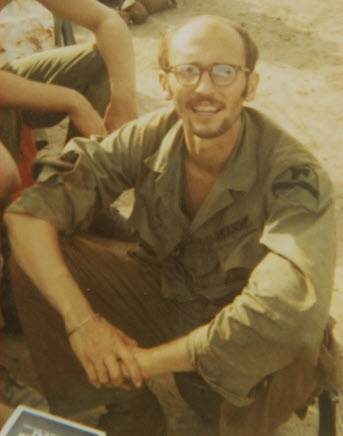
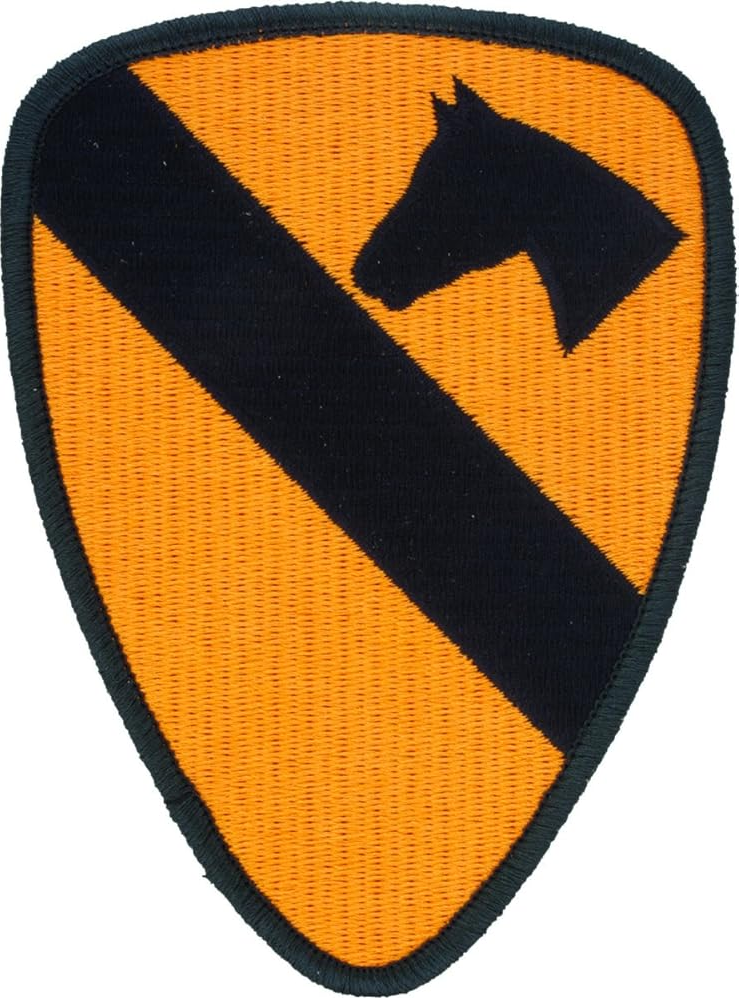
After a one-week in-country tactical update on current booby-trap types and Viet Cong methodology, he was transported to a forward triangular firebase in Military Region 3 to join his company, Delta Company, 1st Battalion, 8th Cavalry, 1st Cavalry Division (Airmobile). The company was back on the firebase between missions. His Company Commander was from Eldridge, Iowa — a fact he discovered when he went to argue his first in-country assignment. His platoon lieutenant was a Dartmouth graduate who referred to their tactical column, with a certain wry affection, as the "OD Circus."
In his first week in-country, his squad leader assigned him to walk point. He went to the Company Commander. The CO's explanation was brief: Army policy was to avoid creating orphans and widows. Was Kint married? No. Did he have children? He counted his former students; the CO did not. Someone had just DEROSed back to the States, the slot needed filling, and Kint fit the profile. He walked point. Three platoons rotated the lead daily, so he held the position roughly one day in three.
In the Bush
His unit operated toward the Cambodian border throughout III Corps. The rear base was Biên Hòa, outside Saigon. He later described his tour as "the easy year" — the 1970 Cambodian Incursion had swept the large NVA supply caches out of the buttress-root hollows of the jungle trees, and by 1971 the contacts his unit encountered were small and localized rather than the massed regimental engagements veterans of the late 1960s described. He did not experience the "days of boredom, seconds of terror" pattern. What he experienced instead was a continuous, unrelenting knot in the stomach — scanning for tripwires, watching for movement in the bamboo, looking for eyes. Every hour of every patrol.
Early in his tour, his platoon swept through a Viet Cong black-pajama uniform factory hidden in the brush: treadle sewing machines, bolts of black cloth, garments half-cut and half-sewn, abandoned moments before the platoon arrived. A VC rear guard opened fire to cover the withdrawal. Kint went down on his back — the exact mistake he had feared since the flour-bag exercise at Fort Polk. Looking straight up at the sky, he watched green enemy tracer rounds tracking down toward his face, converging, getting closer. They stopped. He was certain he was dead. Then they started again, and he rolled over and achieved fire superiority. He described it as his first "I just missed it" moment. There would be others.
Sometime during his tour, he was issued an M16 with an M79 40mm grenade launcher underslung — the "over-under" configuration. He could fire a standard M16 magazine or single-shot 40mm rounds: high explosive, buckshot, marking, or illumination. He wore a dedicated vest with low pouches for the 79 rounds. He kept his pack deliberately stripped to the minimum, knowing he would need to drop to his stomach without being pinned by weight. He went without a helmet when he could manage it, fashioning a headband from the waistband of a pair of underwear and an OD handkerchief as camouflage for his bald head. A subsequent Company Commander ordered him to wear the helmet. He complied and considered it largely irrelevant — if a round was going to find him, it would go through the helmet anyway.
At some point in 1971, while his unit was deep in the bush and entirely cut off from rear communications, Delta Company, 1st Battalion, 8th Cavalry was administratively consolidated into Delta Company, 2nd Battalion, 8th Cavalry as part of the drawdown. Kint and his squad had no idea the redesignation had occurred. They found out later.
The unit participated in Chieu Hoi operations — setting up night locations along known trails to provide safe passage for Vietnamese civilians moving away from VC-controlled areas. The VC, he noted, were not gentle with villagers who tried to leave. His unit didn't shoot at people moving in the dark toward the safe zones. He felt good about that.
He slept on the ground on a poncho, boots on, M16 within reach. At the firebase, he slept inside drainage culvert sections with sandbags overhead — hot, humid, and, as he quickly realized, situated directly on the rat highway between the local rat population and the mess hall. He worried about dying of a rat bite. Wild elephant herds came through the bamboo on three or four nights — feeding during the cool hours, easily spooked, capable of trampling anything in their path. He did not find this amusing. Monkeys played in the trees on other nights and he hoped nobody would open fire on them.
He carried C-rations and MREs, heating the freeze-dried meals with water and heat tabs. Everyone carried Heinz 57, A1 sauce, or hot sauce. The pound cake from the C-rations was worth keeping; most of the rest was not. A PX catalog — as thick as a Sears catalog — circulated through the unit. He ordered a camera from the PX at some point and documented very little with it. He carried family photos and writing materials in his pack.
The radio handset was passed around the perimeter through the night. Guard was acknowledged by breaking squelch twice — pressing the button, no words, just the sound. No voices, no position given away.
A few times during 1971, packets of letters arrived from Iowa. A colleague — an older female English teacher he had worked with before the war — had been forwarding 8th grade English assignments to him. They were formal exercises: complete sentences, proper punctuation, structured paragraphs. Other soldiers in the unit wanted to read them. Reading them gave Kint the only sensation that approaching the whole thing made sense — that surviving it might be worth something. He had no wife or children to think about. The letters were his one psychological anchor.
He still wears a Montagnard bracelet, made by hill people of III Corps from stripped electrical cord insulation. They wanted American goods; the Army issued military payment certificates instead of dollars to prevent a black market. He has no memory of making it to any villages.
The Rear and Vũng Tàu
After approximately ten months in the bush, he was pulled back to Biên Hòa Air Base and assigned as company clerk typist. It was the first moment he allowed himself to believe he might make it home. Hot showers. A mess hall. Movies projected onto the side of a building. He stayed within the 1st Cavalry compound and did not go into the town. He typed his own DEROS paperwork.
He made three trips to Vũng Tàu during his tour. The first two were in-country R&R passes while he was still in the bush — granted after contacts, quickly helicoptered to a strip, then loaded onto a C-130 that climbed out at an angle that made him grip the webbing and look straight down out the back of the aircraft. Three days each time. Vũng Tàu was the old French resort town on the coast, with hotels, restaurants, and beaches that the colonial period had built and the war had not yet destroyed. The military ran an R&R welcome center there: tents, cots, a mess hall, surfboards available to rent. He wandered the streets. He rode the public transportation. He lay on the beach. He knew there were no snipers and no land mines. He described it as a quantum leap from his day-to-day experience. He has photographs from Vũng Tàu.
His third trip was a logistics run as clerk. He and the First Sergeant drove a jeep towing a supply trailer loaded with clean shirts, trousers, and other supplies from Biên Hòa down to the R&R center. He saw a rear-echelon soldier cruising the streets of town on a Honda 750 with a custom fuel tank. He did not consider this fair.
Coming Home
He departed Vietnam approximately December 8, 1971 — two days short of a full twelve-month tour. The Army's standard compression policy for Christmas-season DEROSes had trimmed the last days off his calendar. He had missed the Bob Hope Christmas show in 1970 as a cherry; he was gone before the 1971 show arrived.
He processed out through Oakland, California, in the middle of the night. He ate the one free steak the Army provided at two o'clock in the morning. He had been told — all of them had been told — to wear civilian clothes for the transit home, to blend in. The only civilian clothes available were from the PX: plaid shirts, form-fitting slacks, nothing resembling the bell-bottom era outside the gate. He looked, he acknowledged, extraordinarily dorky. His buzzcut and the olive-drab duffel bag completed the picture. He sat at the airport before it opened, first in line. People looked. Nobody said anything.
He flew to Cedar Rapids, Iowa. His parents, his aunt, and his uncle met him at the airport in the middle of the night. Nobody asked what he had done. They were glad he was home.
He spent the following month in Manchester at Christmas. The transition was easier than he had expected. He bought his first motorcycle. Friends took him riding on their farms, through the woodlots. They went to work during the day; he went back to where they had ridden and kept moving. He described it as decompression. He doesn't know if it would have worked for everyone, but it worked for him.
Return to the Classroom
Public school districts are legally exempt from the federal statutes requiring employers to reinstate returning veterans at their earned pay level. His principal had not known this. The principal had held his position anyway, filling it year by year with spouses of Palmer College of Chiropractic students in Davenport — temporary by design, gone when their husbands graduated. The job was waiting when Kint returned.
When he reviewed his contract at the start of the 1972 school year, it listed him as a fourth-year teacher. Under the federal law that applied to every other employer in the country, he should have been credited for the years he would have accumulated had he not been drafted. He put on the suit he had tailored in Hong Kong during an R&R, went to the school board, and made his case.
Two board members took exception. He told them that if he had spent his service behind a desk stateside, he would not be standing there — he would have been glad to have his job back at any pay grade. He had been shot at. He had shot at people. This was not how it worked anywhere else. The board members reminded him that they did not, in fact, have to follow the same rules as anywhere else.
The superintendent asked his secretary to retrieve the personnel file of a vocal music teacher who had started in the district in 1967 alongside Kint, been drafted in 1968, and returned in 1970. Someone in the district — through clerical good faith or simple mistake — had placed him at his correct step upon return. The superintendent slid the folder in front of the board member who had most forcefully opposed Kint's claim. The board member opened it, went visibly pale, slammed it shut, and said nothing further. The superintendent noted that it appeared the district had an established precedent.
Kint won. He returned to teaching junior high science and mathematics at his earned pay grade. He did not discuss his service with his students. He managed the flashbacks that came — a student's challenging tone, a noise, something in the air. He kept a lid on it and was later surprised that he had managed to. The board member's two sons eventually came through his classroom. He treated them well.
He never again landed on his back.